Guidelines Purpose and Scope
-
The Ministry of Environment, Forest and Climate Change (MoEF&CC) has notified Wetlands
(Conservation and Management) Rules, 2017 (hereinafter Wetlands Rules) under the provisions
of the Environment (Protection) Act, 1986 as regulatory framework for conservation and
management of wetlands in India. These guidelines have been drafted to support the State
Governments / Union Territory (UT) Administrations in the implementation of the Rules by
providing guidance on:
- Preparing a list of wetlands in the State / UT
- Identifying wetlands for notification under Wetlands (Conservation and Management) Rules,2017
- Delineating wetlands, wetlands complexes and zone of influence
- Preparation of Brief Document
- Determining ‘wise use’ and ecological character
- Developing a list of activities to be regulated and permitted
- Developing an Integrated Management Plan
- Constitution and operational matters of the Wetlands Authorities
- Overlapping provisions.
-
These guidelines were drafted by a committee constituted by the MoEF&CC vide OM dated
August 10, 2018. The committee comprised Mr U.A.Vora (former CCF Wildlife, Government
of Gujarat), Dr Arvind Kumar (President, India Water Foundation), Dr B.C. Jha (Former
Director (Wetlands), Central Inland Fisheries Research Institute), Dr P. S. N. Rao (Director,
School of Planning and Architecture), Dr Afroz Ahmad (Member, Environment and
Rehabilitation, Narmada Control Authority) and Dr Ritesh Kumar (Director, Wetlands
International South Asia). The committee met on five occasions at MoEF&CC, New Delhi for
the said purpose, and submitted final version of the guidelines to the Ministry on December 5,
2018. The draft guidelines were subsequently sent for comments to all State Governments / UT
Administrations, and have been finalized after due consideration of the comments received. The
Committee immensely benefitted from the discussions held with Ms Manju Pandey (Joint
Secretary). The Committee also acknowledges the support received from Ms Rita Khanna
(Scientist ‘F’), Dr M. Ramesh (Scientist ‘E’), Mr Chandan Singh (Scientist ‘D’), Dr Anu Chetal
(Research Assistant) and Ms Pallavi Mukherjee (Research Assistant) during the guidelines
preparation process.
Wetlands to be regulated
-
The provisions of Wetlands Rules apply to:
- Wetlands designated by the Government of India to the List of Wetlands of International
Importance under the provisions of the Convention on Wetlands (Ramsar Convention).
[Ref. Rule 3 (a) of Wetlands Rule]
- Wetlands notified under the rules by the Central Government, State Government and UT
Administration. [Ref. Rule 3 (b) of Wetlands Rule]
- All wetlands, irrespective of their location, size, ownership, biodiversity, or ecosystem services
values, can be notified under the Wetlands Rules, except:
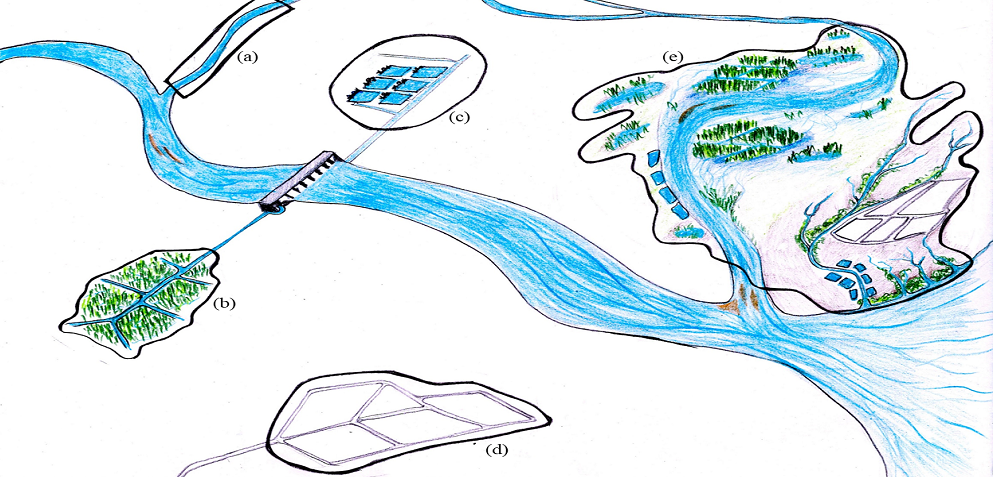
- River channels
- Paddy fields
- Human-made waterbodies specifically constructed for drinking water purposes
- Human-made waterbodies specifically constructed for aquaculture purposes
- Human-made waterbodies specifically constructed for recreation purposes
- Human-made waterbodies specifically constructed for recreation purposes
- Human-made waterbodies specifically constructed for irrigation purposes
- Wetlands falling within areas covered under the Indian Forest Act, 1927; Forest
(Conservation) Act, 1980; State Forest Acts and amendments thereof
- Wetlands falling within areas covered under the Wildlife (Protection) Act, 1972 and
amendments thereof
- Wetlands falling within areas covered under the Coastal Regulation Zone Notification, 2011
and amendments thereof
-
Human-made wetlands are defined as wetlands that are planned, designed and operated to meet
a specific purpose (such as providing water for irrigation, producing fish through culture
operations, producing salt, recreation, preventing salinity intrusion, flood control etc.). Only
those human-made wetlands that have been built for purposes, mentioned at paras 4c) – 4g)
above, are excluded from notification under these Rules
-
Natural wetlands, partly or wholly used for purposes as mentioned at 4c) – 4g), attract the
provisions of the Wetlands Rules.
- Wetlands designated as Ramsar Sites may be notified under the Rules as per the process
mentioned in paragraphs 57-65, even when partly or wholly overlapping with areas covered under
the Indian Forest Act, 1927; Forest (Conservation) Act, 1980; State Forest Acts and amendments
thereof; Wildlife (Protection) Act, 1972 and amendments thereof; Coastal Regulation Zone
Notification, 2011 and amendments thereof. Regulations for parts of wetlands overlapping with
4h-4j (supra) will, however, be as per the corresponding regulatory framework. Ramsar site areas,
not covered under any of the overlapping laws and rules, will attract the provisions of the
Wetlands Rules (Refer illustration 1 below).
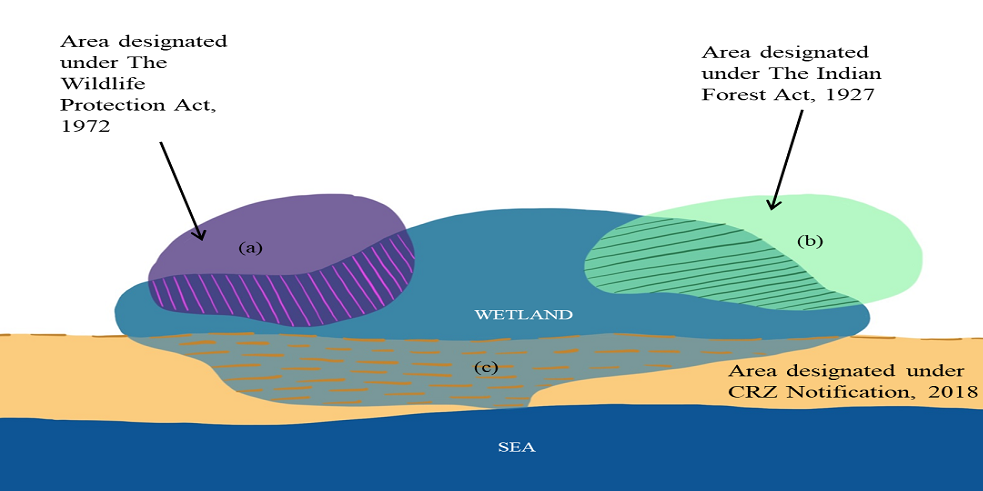
- For wetlands falling within the criteria 3 (b) (supra), the exclusions mentioned at para 4 a) – 4j)
shall apply only in cases wherein the entire wetland falls under the said category. In cases wherein
areas falling within para 4 a) – 4 j) form a part of larger wetland or wetlands complex, and
exclusion may result in impeded ecological contiguity and connectivity, such areas may be
included within the boundary of wetland being notified. Regulations within the boundaries of
areas mentioned at para 4 h) – 4 j) will, however, be as per the corresponding regulatory
frameworks (Refer Illustration 1 and 2).
- Though Protected Areas and areas falling within the purview of Coastal Zone Regulation have
been excluded from notification under the Wetlands Rules, management of such wetlands may
benefit through the application of ‘wise use’ approach (within the framework of existing laws and
rules) as outlined in Section VII of these guidelines.